The Super Bowl was in three hours and I’d completely forgotten I was supposed to be hosting the snack spread. Everyone else would be bringing their famous dips, their seven-layer nachos, their slow-cooker meatballs that had been simmering all day. I had a massive, bone-in prime rib roast sitting in my fridge that I’d bought on a whim for a fancy Christmas dinner that never happened. Talk about mismatched expectations. I stood there, staring at this gorgeous hunk of beef, wondering if I could somehow turn it into something that belonged on a coffee table next to chicken wings. My buddy Dave texted asking if I needed ice, and I almost cried. But necessity is the mother of invention, right? I grabbed my garlic, my herb stash, and decided to just go for it. I mean, how hard could it be? I threw together a simple garlic herb paste, rubbed that roast down like it owed me money, and cranked the oven. The apartment smelled insane within twenty minutes—like a steakhouse had somehow materialized in my tiny kitchen. People started arriving early, drawn by the smell, and I was still in my sweats, frantically slicing. Let me tell you, that prime rib roast completely stole the show. Nobody cared about the chips I’d dumped in a bowl. They wanted more of that garlic herb perfection. Honestly, maybe you’ve been there—caught off guard, underprepared, but somehow stumbling into a win. That’s how this recipe became my game day secret weapon. It’s the kind of dish that makes you look like you planned it all along, even when you absolutely did not.
Why You’ll Love This Recipe
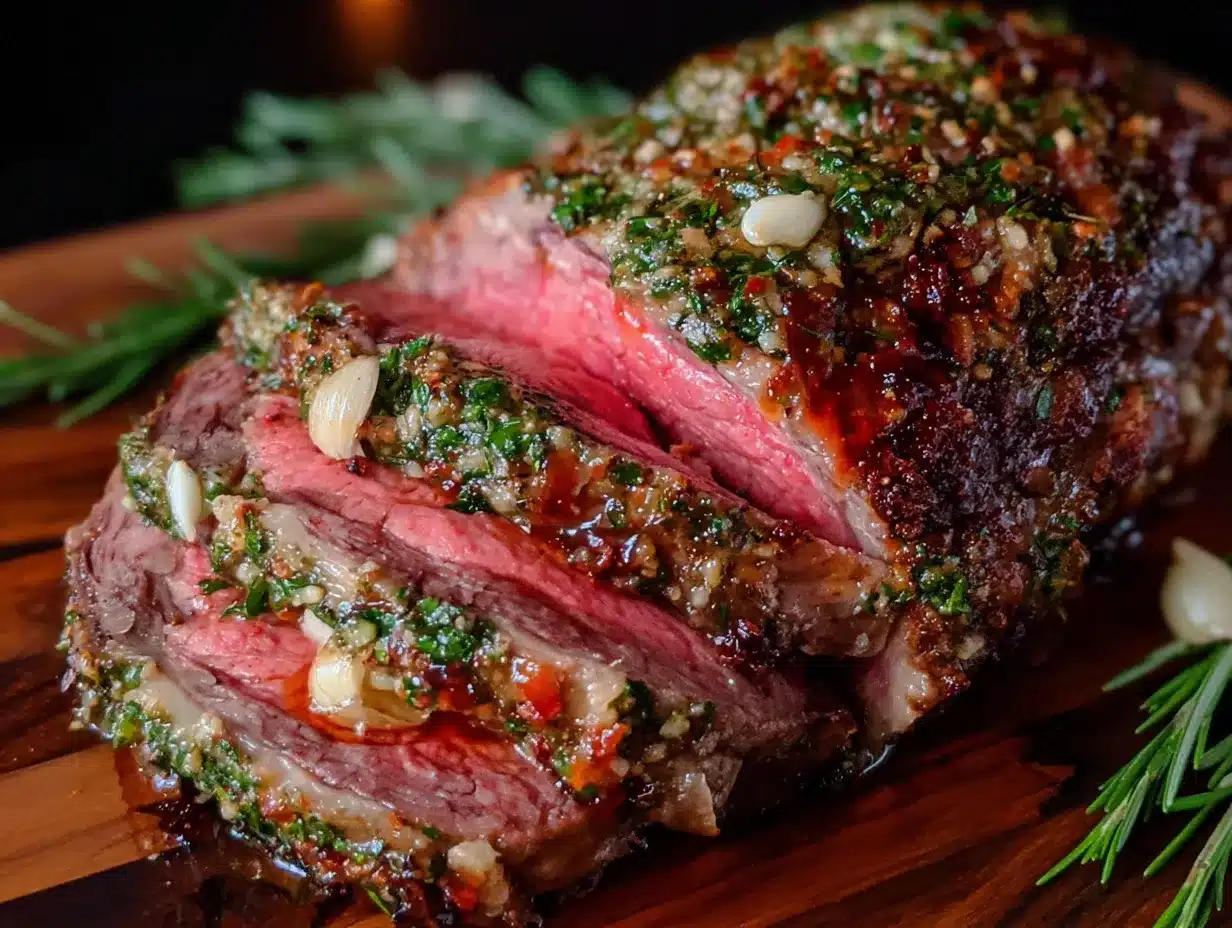
Let me be real with you—this isn’t just another prime rib recipe. I’ve tested this method about seven times now, tweaking the garlic-to-herb ratio, adjusting the roasting temperature, and even ruining a perfectly good roast by overcooking it (rest in peace, that $80 piece of beef). What I landed on is pure gold. This garlic herb prime rib roast gives you that stunning, crusty exterior with a melt-in-your-mouth, rosy center that looks like it came from a fancy steakhouse. But here’s the kicker—it’s actually super straightforward.
- Game Day Showstopper: This isn’t your average snack spread hero. It’s the main event that has people hovering around the kitchen island, waiting for the next slice.
- Surprisingly Simple: Despite looking incredibly impressive, the prep work takes about 15 minutes. The oven does the heavy lifting.
- Incredible Leftovers: Cold prime rib sandwiches the next day? Yes, please. It might even be better than the fresh roast.
- Foolproof Method: The low-and-slow then high-heat sear technique ensures you get perfect doneness every single time, from edge to center.
- Crowd-Pleasing Flavor: That garlic herb crust is aromatic and savory without being overpowering. It complements the beef, it doesn’t mask it.
This recipe is different because of the technique. Most recipes tell you to sear first, then roast. I do the opposite—roast low and slow first, then blast it with high heat at the end. It creates a more even cook and a crust that shatters when you slice it. Honestly, it’s the kind of meal that makes you close your eyes after the first bite. Perfect for impressing your game day crowd without spending the whole game in the kitchen.
What Ingredients You Will Need
This recipe relies on a handful of high-quality ingredients to deliver that deep, savory flavor and beautiful crust. Nothing here is complicated, but choosing the right components makes all the difference. Here’s what you’ll need:
- Prime Rib Roast (bone-in, 4-6 pounds): Bone-in is non-negotiable for me. The bones act as a natural roasting rack and add incredible flavor to the meat. Look for a roast with good marbling—those white streaks of fat running through the meat are what keep it juicy. I typically ask my butcher for a “first cut” or “small end” roast for the most tender results.
- Fresh Garlic (8-10 cloves): Please, please use fresh garlic. The pre-minced stuff in a jar has a sharp, almost metallic taste that just doesn’t work here. You want the sweet, pungent flavor that only fresh garlic can provide. I usually go a little heavy-handed because I love garlic.
- Fresh Rosemary (2 tablespoons, finely chopped): Rosemary and beef are a classic pairing for a reason. It adds an earthy, piney aroma that cuts through the richness of the roast. Strip the leaves from the woody stems before chopping.
- Fresh Thyme (1 tablespoon, leaves stripped): Thyme is more subtle than rosemary, but it adds a layer of complexity that you’ll miss if you skip it. It has a slightly lemony, floral note that brightens the whole dish.
- Olive Oil (3 tablespoons): Use a good quality extra virgin olive oil. It helps bind the garlic and herbs into a paste and aids in creating that gorgeous crust. Don’t use a cheap, bland oil here.
- Coarse Kosher Salt (2 tablespoons): I prefer Diamond Crystal kosher salt for its clean flavor and easy-to-pinch texture. It’s less salty by volume than table salt, so if you’re using table salt, reduce the amount to about 1 1/2 tablespoons.
- Freshly Ground Black Pepper (1 tablespoon): Freshly ground is key. Pre-ground pepper lacks that punchy, aromatic quality. Be generous with it—pepper is a crucial part of the crust.
- Unsalted Butter (2 tablespoons, softened): Adding a little butter to the garlic herb paste enriches the flavor and helps the crust brown beautifully. It also adds a touch of richness to the final pan juices.
Equipment Needed
You don’t need a professional kitchen to pull this off, but having the right tools makes the process smoother. Here’s what I use every single time:
- Roasting Pan with a Rack: A sturdy roasting pan is essential. The rack elevates the roast so hot air circulates around it, ensuring even cooking. If you don’t have a rack, you can use a few rolled-up balls of aluminum foil to lift the roast off the bottom of the pan.
- Instant-Read Meat Thermometer: This is your most important tool. Guessing doneness is a recipe for disaster. I use a Thermapen—it’s pricey, but it gives an instant and accurate reading. A basic digital probe thermometer works great too.
- Chef’s Knife: A sharp, heavy chef’s knife makes mincing garlic and herbs effortless. It’s also crucial for cleanly slicing the finished roast.
- Small Food Processor or Mortar and Pestle: You can mince everything by hand, but a food processor makes the garlic herb paste in seconds. I’ve used both—the mortar and pestle gives a more rustic texture, but the food processor is faster.
- Kitchen Twine: If your roast isn’t already tied, you’ll need twine to secure it. This helps it cook evenly and maintain a nice shape.
- Aluminum Foil: You’ll need this for tenting the roast while it rests. Don’t skip the resting step!
Preparation Method
Alright, let’s get cooking. This method might seem backward to some, but trust me, it works. The key is patience and a good thermometer.
- Take the Chill Off (1 hour before cooking): Remove your prime rib roast from the refrigerator about 1 hour before you plan to cook it. This is crucial. A cold roast straight from the fridge will cook unevenly, with the outside overdone before the center is even warm. Let it sit on the counter, still wrapped, to come up to room temperature.
- Make the Garlic Herb Paste (5 minutes): While the roast is resting, make the paste. In a small food processor, combine the 8-10 peeled garlic cloves, 2 tablespoons chopped rosemary, 1 tablespoon thyme leaves, 3 tablespoons olive oil, 2 tablespoons softened butter, 2 tablespoons kosher salt, and 1 tablespoon black pepper. Pulse until it forms a thick, fragrant paste. Scrape down the sides as needed. If you’re doing it by hand, mince the garlic and herbs as finely as possible, then mash them together with the salt, pepper, oil, and butter using the side of your knife or a mortar and pestle.
- Season the Roast (10 minutes): Pat the prime rib roast dry with paper towels. This is important—moisture is the enemy of a good crust. Place the roast on a cutting board or in the roasting pan. Using your hands, rub the garlic herb paste all over the entire surface of the roast. Don’t be shy. Get it into every nook and cranny. If your roast is tied, make sure to get the paste under the twine as well. Let the seasoned roast sit at room temperature for another 15-20 minutes while your oven preheats.
- Preheat the Oven (15 minutes): Preheat your oven to 250°F (120°C). Yes, 250°F. This low temperature is the secret to an evenly cooked, perfectly pink prime rib from edge to edge. Position your oven rack in the center of the oven.
- Roast Low and Slow (2.5 to 3.5 hours): Place the seasoned roast, bone-side down, on the rack in your roasting pan. Insert your meat thermometer into the thickest part of the roast, making sure it’s not touching any bone. Roast at 250°F until the internal temperature reaches about 115°F (46°C) for medium-rare. This usually takes about 25-30 minutes per pound for a 4-6 pound roast. Start checking the temperature about 30 minutes before you think it will be done. The temperature will rise as it rests, so you want to pull it out a bit early.
- The High-Heat Sear (15-20 minutes): Once the roast hits 115°F, remove it from the oven. Increase the oven temperature to 500°F (260°C) or as high as it will go. While the oven is heating up, tent the roast loosely with foil. This allows the internal temperature to stabilize. Once the oven is screaming hot, remove the foil and return the roast to the oven. Roast for 10-15 minutes, or until the crust is deeply browned and sizzling. Keep a close eye on it—it can go from perfect to burnt very quickly at this temperature.
- Rest, Rest, Rest (20-30 minutes): This is the most important step. Remove the roast from the oven and transfer it to a cutting board. Tent it loosely with foil and let it rest for at least 20-30 minutes. Do not skip this. The resting period allows the juices to redistribute throughout the meat. If you slice it immediately, all those beautiful juices will end up on your cutting board instead of in your mouth. The internal temperature will also continue to rise during this time, reaching about 125-130°F (52-54°C) for perfect medium-rare.
- Slice and Serve (5 minutes): After resting, remove the kitchen twine. Place the roast on a clean cutting board. Using a sharp chef’s knife, slice the meat off the bones in one large piece. Then, slice the boneless roast against the grain into 1/2-inch to 3/4-inch thick slices. Arrange the slices on a warm platter, spoon any accumulated juices from the cutting board over the top, and serve immediately.
Cooking Tips & Techniques
I’ve made this roast probably a dozen times now, and I’ve learned a few things the hard way. Here are my best tips to ensure your garlic herb prime rib is perfect every time.
Don’t Skip the Salting: I used to be timid with salt, worried about overdoing it. With a large roast like this, you need a generous hand. The salt doesn’t just add flavor—it helps draw out moisture from the surface, which then evaporates, leaving you with a drier surface that browns better. I learned this after making a few roasts with a pale, sad crust.
Thermometer is King: I cannot stress this enough. The difference between a perfect medium-rare and a well-done disaster is only a few degrees. I once tried to “eyeball” the doneness by poking the meat. I ended up with a medium-well roast that was still tasty, but nowhere near as juicy and tender. Buy a good instant-read thermometer. It’s the best investment you’ll make for this recipe.
The Reverse Sear is Magic: The low-then-high method, known as reverse searing, is the only way I cook prime rib now. Traditional searing first can lead to a grey band of overcooked meat just under the crust. The reverse sear gives you a perfectly even pink interior from edge to edge. The high heat at the end is just for that beautiful, flavorful crust.
Let It Rest: I know it’s tempting to slice right into that glorious roast, especially when everyone is hungry and the game is about to start. But please, be patient. I once rushed the resting period by about 10 minutes, and when I sliced the roast, a pool of red juice flooded my cutting board. It was heartbreaking. Give it the full 20-30 minutes. Your patience will be rewarded.
Make Gravy from the Drippings: Don’t let those pan drippings go to waste! After you remove the roast, place the roasting pan on the stovetop over medium heat. Add a splash of beef broth or red wine and scrape up all the browned bits from the bottom. Whisk in a little flour or cornstarch slurry to thicken it into a rich, savory au jus or gravy. It’s the perfect finishing touch.
Variations & Adaptations
This recipe is fantastic as written, but it’s also incredibly versatile. Here are a few ways I’ve adapted it over the years to suit different cravings and dietary needs.
- Spicy Chipotle Herb Crust: For a smoky, spicy kick, add 1-2 chipotle peppers in adobo sauce (minced) to the garlic herb paste. It adds a wonderful depth of flavor and a subtle heat that pairs beautifully with the beef. I made this version for a playoff game once, and it was gone in minutes.
- Herb-Crusted with Horseradish Cream: The classic pairing. Serve the roast with a simple horseradish cream sauce on the side. Mix 1/2 cup sour cream, 2 tablespoons prepared horseradish (drained), 1 tablespoon fresh lemon juice, and a pinch of salt and pepper. It cuts through the richness of the beef perfectly.
- Low-Carb/Keto-Friendly: This recipe is already naturally low-carb and keto-friendly. Just skip any flour-based gravy and serve the roast with the natural pan juices. The high-fat content from the marbling and the butter in the crust make it a perfect fit for a ketogenic diet.
- Individual Prime Rib Roasts: If you’re cooking for a smaller crowd, you can use this same method for individual bone-in ribeye steaks (about 1-inch thick). Reduce the low-temperature roasting time to about 20-25 minutes, then sear them in a hot cast-iron skillet instead of the oven.
Serving & Storage Suggestions
How you serve and store this roast can make a big difference in the overall experience. Here’s what I’ve found works best.
Serving: Serve the prime rib roast slices on a warm platter. I like to arrange them slightly overlapping, almost like a fan. Spoon a little of the accumulated juices over the top just before serving. For game day, I set out small plates and forks, but honestly, people often just grab slices with their hands—it’s that kind of party. The roast is best served immediately after resting, while it’s still warm and the crust is crisp.
Complementary Sides: This roast is rich and flavorful, so I like to pair it with simple sides that don’t compete. Creamy mashed potatoes are a classic choice. A bright, acidic salad with a vinaigrette helps cut through the richness. Roasted asparagus or green beans with a squeeze of lemon are also excellent. For a game day spread, I also put out a basket of crusty rolls for making sandwiches.
Storage: Leftover prime rib is a gift. Store any leftover slices in an airtight container in the refrigerator for up to 4 days. The flavors actually meld and deepen overnight. I find the cold slices are incredible for sandwiches the next day.
Reheating: The key to reheating prime rib is to do it gently so you don’t dry it out. The best method is to place slices in a single layer in a baking dish, add a splash of beef broth or au jus, cover with foil, and warm in a 300°F (150°C) oven for about 10-15 minutes. You can also reheat slices in a hot skillet with a little butter for about 1-2 minutes per side. Avoid the microwave—it will turn your beautiful pink roast into a tough, grey piece of leather.
Flavor Development: Honestly, the leftovers are sometimes even better than the fresh roast. The garlic and herb flavors have more time to meld with the beef. Cold prime rib, thinly sliced on a crusty baguette with some horseradish cream and arugula? That’s a game day win all over again.
Nutritional Information & Benefits
While this is definitely an indulgent dish, there are some nutritional benefits to be aware of. A 4-ounce serving of prime rib (about the size of a deck of cards) provides a significant amount of high-quality protein, which is essential for muscle repair and satiety. It’s also a good source of iron and B vitamins, particularly B12, which is crucial for energy production and nerve function.
Here are the approximate nutritional values per 4-ounce serving (without gravy):
| Nutrient | Amount |
|---|---|
| Calories | 350-400 |
| Protein | 25-30g |
| Fat | 28-33g |
| Saturated Fat | 12-15g |
| Carbohydrates | <1g |
| Sodium | 600-800mg (varies with salt) |
This recipe is naturally gluten-free and low-carb, making it suitable for many dietary preferences. The primary allergen concern is dairy from the butter, which can easily be substituted with a high-quality vegan butter or additional olive oil. From a wellness perspective, I see this as a wonderful treat for special occasions. It’s rich, satisfying, and meant to be enjoyed mindfully with friends and family.
Conclusion
So there you have it—my go-to recipe for a show-stopping garlic herb prime rib roast that’s perfect for game day or any special occasion. It looks incredibly impressive, but the method is surprisingly simple. That low-and-slow roast followed by a high-heat sear gives you perfectly even doneness and a gorgeous, flavorful crust every single time. I love this recipe because it always delivers. It turns a potentially stressful cooking experience into a confident, almost relaxing one. You can actually hang out with your guests instead of being chained to the oven.
I really hope you give this a try. Don’t be afraid to make it your own—adjust the herb ratio, add a little spice, or serve it with your favorite sides. And please, let me know how it turns out! Drop a comment below and tell me about your game day feast or any twists you added. Did your crowd love it as much as mine did? I can’t wait to hear about your garlic herb prime rib adventures. Happy cooking, and enjoy the game!
Frequently Asked Questions
Can I use a boneless prime rib roast?
Yes, you can. The cooking time will be slightly shorter since there’s no bone to conduct heat. I recommend reducing the roasting time by about 10-15 minutes per pound and relying on your meat thermometer for doneness.
What if I don’t have fresh herbs?
Dried herbs can be used in a pinch, but the flavor will be less vibrant. Use about 1 teaspoon of dried rosemary and 1/2 teaspoon of dried thyme instead of the fresh amounts. The texture of the crust will also be different—less rustic and more powdery.
How do I know when the roast is done without a thermometer?
Honestly, I strongly recommend using a thermometer for the best results. Without one, you can use the “hand test” by comparing the firmness of the meat to the fleshy part of your hand, but it’s not very precise. For medium-rare, the meat should feel slightly springy but still give a little resistance.
Can I prepare the garlic herb paste ahead of time?
Absolutely! The paste can be made up to 2 days in advance and stored in an airtight container in the refrigerator. Let it come to room temperature for about 20 minutes before rubbing it onto the roast so it spreads more easily.
My roast came out more medium than medium-rare. What went wrong?
This usually happens if the oven temperature was too high during the initial roasting phase, or if you left the roast in the oven too long before the high-heat sear. Make sure your oven is accurately calibrated and always start checking the internal temperature about 30 minutes before you expect it to be done. Also, remember that the temperature will rise about 5-10°F during the resting period.
Pin This Recipe!
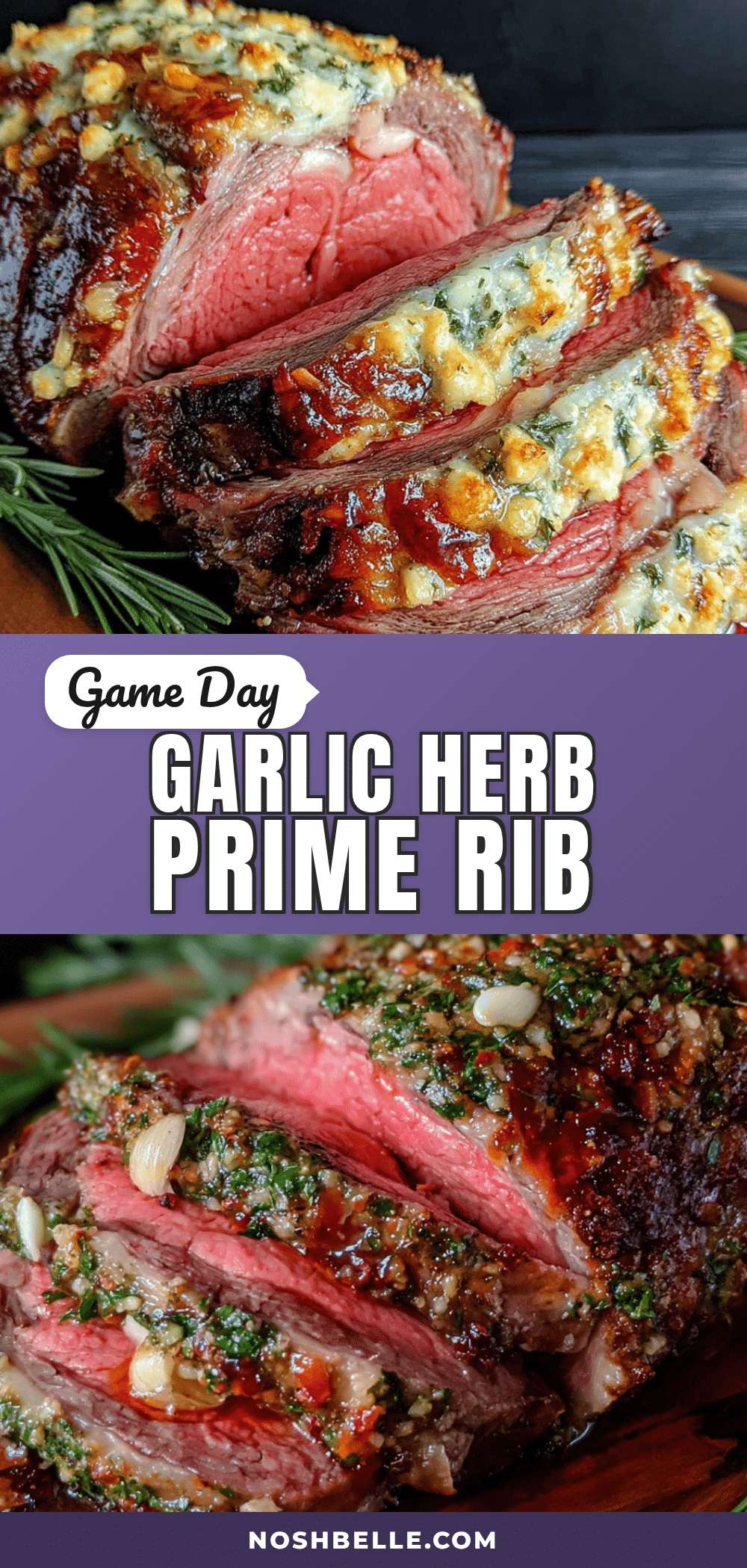
Best Garlic Herb Prime Rib Roast for Game Day (Easy Perfection)
A show-stopping garlic herb prime rib roast that’s perfect for game day or any special occasion. The low-and-slow roast followed by a high-heat sear gives you perfectly even doneness and a gorgeous, flavorful crust every single time.
- Prep Time: 15 minutes
- Cook Time: 2 hours 45 minutes to 3 hours 45 minutes
- Total Time: 3 hours to 4 hours 30 minutes
- Yield: 8-12 servings
- Category: Main Course
- Cuisine: American
Ingredients
- Prime rib roast (bone-in, 4-6 pounds)
- Fresh garlic (8-10 cloves)
- Fresh rosemary (2 tablespoons, finely chopped)
- Fresh thyme (1 tablespoon, leaves stripped)
- Olive oil (3 tablespoons)
- Coarse kosher salt (2 tablespoons)
- Freshly ground black pepper (1 tablespoon)
- Unsalted butter (2 tablespoons, softened)
Instructions
- Take the Chill Off (1 hour before cooking): Remove your prime rib roast from the refrigerator about 1 hour before you plan to cook it. Let it sit on the counter, still wrapped, to come up to room temperature.
- Make the Garlic Herb Paste (5 minutes): In a small food processor, combine the 8-10 peeled garlic cloves, 2 tablespoons chopped rosemary, 1 tablespoon thyme leaves, 3 tablespoons olive oil, 2 tablespoons softened butter, 2 tablespoons kosher salt, and 1 tablespoon black pepper. Pulse until it forms a thick, fragrant paste.
- Season the Roast (10 minutes): Pat the prime rib roast dry with paper towels. Using your hands, rub the garlic herb paste all over the entire surface of the roast. Let the seasoned roast sit at room temperature for another 15-20 minutes while your oven preheats.
- Preheat the Oven (15 minutes): Preheat your oven to 250°F (120°C). Position your oven rack in the center of the oven.
- Roast Low and Slow (2.5 to 3.5 hours): Place the seasoned roast, bone-side down, on the rack in your roasting pan. Insert your meat thermometer into the thickest part of the roast. Roast at 250°F until the internal temperature reaches about 115°F (46°C) for medium-rare.
- The High-Heat Sear (15-20 minutes): Once the roast hits 115°F, remove it from the oven. Increase the oven temperature to 500°F (260°C). Tent the roast loosely with foil. Once the oven is hot, remove the foil and return the roast to the oven. Roast for 10-15 minutes, until the crust is deeply browned.
- Rest, Rest, Rest (20-30 minutes): Remove the roast from the oven and transfer it to a cutting board. Tent it loosely with foil and let it rest for at least 20-30 minutes.
- Slice and Serve (5 minutes): After resting, remove the kitchen twine. Slice the meat off the bones in one large piece. Then, slice the boneless roast against the grain into 1/2-inch to 3/4-inch thick slices. Arrange on a warm platter, spoon any accumulated juices over the top, and serve immediately.
Notes
The reverse sear method (low then high heat) ensures even cooking and a perfect crust. Let the roast rest for at least 20-30 minutes before slicing to retain juices. Make gravy from pan drippings by adding beef broth or red wine and thickening with flour or cornstarch.
Nutrition
- Serving Size: 4 ounces
- Calories: 375
- Sodium: 700
- Fat: 30
- Saturated Fat: 13
- Carbohydrates: 1
- Protein: 27
Keywords: prime rib, garlic herb prime rib, game day recipe, roast beef, holiday roast, reverse sear prime rib