My brother had sworn he hated squash for thirty-seven years. Thirty-seven years. He’d push any orange-tinged vegetable to the edge of his plate like it might bite him. Then, last November, I made this soup purely for myself on a drizzly Tuesday, and I caught him standing over the stove, spoon in hand, mid-sip from the pot. He didn’t even have the decency to look embarrassed. He just blinked at me and said, “This isn’t squash.”
Oh, but it was. It absolutely was.
I had been tinkering with kabocha squash for weeks, trying to get the texture just right. The first attempt was too watery, the second too sweet. I was about to give up entirely when a neighbor—the one who grows pumpkins in her front yard like they’re prize-winning roses—handed me a kabocha and said, “Don’t peel it. Roast it whole, skin and all.” I thought she was crazy. Honestly, I almost laughed. But I was tired of fighting with that tough green rind, so I took her advice. And you know what? She was right. That single tip changed everything.
The power went out halfway through my second test batch. There I was, standing in the dark, holding a spoonful of soup I could barely see, and it was still the most velvety thing I’d ever made. I finished cooking by flashlight, stirring with one hand and holding my phone with the other. It felt ridiculous. But that bowl of soup, warm and golden in the dim light, was the moment I knew I had something special. Something worth sharing.
Maybe you’ve been there—staring at a kabocha squash in the grocery store, wondering what on earth to do with it. Or maybe you’re a squash lover already, looking for a version that feels a little more indulgent, a little more satisfying. Either way, this creamy kabocha squash soup with coconut milk is the one that changed my brother’s mind. And honestly? It might just change yours too.
Why You’ll Love This Recipe
I’ve tested this creamy kabocha squash soup with coconut milk more times than I care to count, and every single batch has taught me something new. The version I’m sharing today is the one that finally felt right—balanced, silky, and deeply comforting without being heavy. This isn’t just another squash soup recipe. It’s the one I keep coming back to, and here’s why you will too.
- Quick & Easy: From start to finish, this soup comes together in about 45 minutes. Most of that time is hands-off roasting, so you can chop a few things while the oven does the hard work.
- Simple Ingredients: No fancy grocery trips here. You’ll find everything at a standard supermarket—kabocha squash, coconut milk, onion, garlic, ginger, and a few pantry staples. That’s it.
- Perfect for Cozy Nights: This soup was made for rainy evenings, chilly weekends, or any time you need a warm hug in a bowl. It’s also elegant enough for company, but easy enough for a Tuesday.
- Crowd-Pleaser: My brother isn’t the only skeptic I’ve converted. This soup has won over squash-haters, veggie-dodgers, and even a few picky toddlers. It’s that good.
- Unbelievably Delicious: The texture is what gets everyone. Roasting the squash with the skin on gives it a natural creaminess that no amount of blending can replicate. Paired with rich coconut milk and a hint of ginger, it’s next-level comfort food.
What makes this recipe different from the rest? It’s the technique. Roasting the kabocha whole, including the edible skin, adds depth and body without any heavy cream or flour. The coconut milk brings a subtle sweetness that complements the squash’s natural nuttiness, while fresh ginger and garlic cut through the richness. It’s comfort food reimagined—healthier, faster, but with the same soul-soothing satisfaction.
This is the kind of soup that makes you close your eyes after the first bite. Seriously. Perfect for impressing guests without stress, or turning a simple meal into something memorable.
What Ingredients You Will Need
This creamy kabocha squash soup with coconut milk uses simple, wholesome ingredients to deliver bold flavor and satisfying texture without the fuss. Most of these are pantry staples or easy to find at any grocery store.
- 1 medium kabocha squash (about 2-3 pounds) — Look for one that feels heavy for its size with dull, firm skin. The skin is edible and adds wonderful texture to the soup. I prefer organic when available, as you’ll be eating the skin.
- 1 can (13.5 oz) full-fat coconut milk — This is non-negotiable for creaminess. Light coconut milk will make the soup watery. I recommend Thai Kitchen or Chaokoh for consistent results.
- 1 medium yellow onion, roughly chopped — Adds savory depth. A sweet onion like Vidalia works beautifully here too.
- 3 cloves garlic, smashed — Smashing rather than mincing gives a milder, sweeter garlic flavor that won’t overpower the squash.
- 1 tablespoon fresh ginger, peeled and grated — Fresh ginger is key. Don’t substitute dried—it won’t give the same bright warmth. Grate it on a microplane for the best texture.
- 2 cups vegetable broth — Use low-sodium so you can control the salt. A good-quality broth makes a difference here. I like Imagine or Pacific Foods.
- 2 tablespoons coconut oil or olive oil — For roasting the squash. Coconut oil reinforces the flavor, but olive oil works fine if that’s what you have.
- 1 teaspoon salt — Start with this and adjust at the end. Different broths have different salt levels.
- ½ teaspoon black pepper — Freshly ground is always better.
- Optional toppings: Toasted pumpkin seeds, a drizzle of coconut cream, fresh cilantro, or a pinch of chili flakes.
Substitution Guidance: For a nut-free version, this recipe is naturally nut-free as written. To make it lower in fat, you can swap half the coconut milk for extra broth, but the texture won’t be as luxurious. If you can’t find kabocha, buttercup or red kuri squash are excellent substitutes. Butternut squash works too, though the flavor will be slightly less sweet and nutty.
One thing I’ve learned the hard way: don’t skip the ginger. The first time I made this, I thought a pinch of ground ginger would be fine. It wasn’t. Fresh ginger gives this soup its signature warmth and helps balance the richness of the coconut milk. Trust me on this one.
Equipment Needed
You don’t need a fancy kitchen to make this creamy kabocha squash soup with coconut milk. Here’s what you’ll need:
- Baking sheet — A rimmed sheet pan works best for roasting the squash. Line it with parchment paper for easy cleanup.
- Sharp chef’s knife — Kabocha squash is dense. A sharp knife makes cutting it in half much safer and easier.
- Large soup pot or Dutch oven — I use my 5.5-quart Le Creuset, but any heavy-bottomed pot will do. The key is even heat distribution.
- Immersion blender or countertop blender — An immersion blender is easier and creates less mess. If using a countertop blender, blend in batches and leave the lid slightly ajar to release steam.
- Vegetable peeler — For the ginger. A spoon works too, but a peeler is faster.
- Microplane or fine grater — For grating the ginger. A box grater works in a pinch.
Budget-friendly alternatives: No immersion blender? Let the soup cool slightly, then transfer it in batches to a regular blender. Just be careful with hot liquids—fill the blender no more than halfway and hold the lid down with a towel. No Dutch oven? Any large, heavy pot will do. Even a stainless steel stockpot works, just stir a little more often to prevent sticking.
I once made this soup using a butter knife to split the squash and a fork to mash it because my blender was broken. It was chunky but still delicious. Don’t let missing equipment stop you.
Preparation Method

Let me walk you through making this creamy kabocha squash soup with coconut milk. I’ve broken it down into clear steps with all the little details I wish someone had told me the first time.
- Preheat your oven to 400°F (200°C). While it heats, carefully cut the kabocha squash in half. This is the trickiest part—the squash is tough. Place it on a stable cutting board, hold it firmly with a towel, and rock your knife through. If it’s too hard, microwave the whole squash for 2 minutes to soften it slightly.
- Scoop out the seeds and stringy bits with a spoon. Don’t throw the seeds away! You can rinse, dry, and roast them with a little salt for a crunchy topping.
- Rub the cut sides of the squash with coconut oil (about 1 tablespoon total). Place both halves cut-side down on a parchment-lined baking sheet. This helps steam the squash as it roasts, keeping it moist.
- Roast for 35-40 minutes, until the flesh is fork-tender. You should be able to pierce it easily all the way through. The skin will look wrinkled and slightly caramelized. Let it cool for 10 minutes—long enough to handle, but still warm.
- While the squash roasts, start the aromatics. In your large pot, heat the remaining 1 tablespoon of coconut oil over medium heat. Add the chopped onion and cook for 5-6 minutes, stirring occasionally, until translucent and starting to brown at the edges. Don’t rush this step—browned onions add sweetness.
- Add the smashed garlic and grated ginger to the pot. Cook for 1 minute, stirring constantly, until fragrant. You should smell the ginger immediately. If it smells burnt, your heat is too high.
- Once the squash is cool enough to handle, scoop the flesh from the skin. Here’s the thing—don’t throw the skin away! I leave about half the skin on because it adds incredible texture and nutrients. Just cut it into chunks with the flesh. If you’re nervous, start with a quarter of the skin and work your way up.
- Add the squash chunks to the pot along with the vegetable broth. Stir everything together and bring it to a gentle simmer over medium-high heat. Reduce the heat to low and let it bubble gently for 10 minutes, stirring occasionally. This allows the flavors to meld.
- Remove the pot from the heat. Let it cool for 5 minutes. If you’re using an immersion blender, blend directly in the pot until completely smooth. If using a countertop blender, work in batches—fill no more than halfway, hold the lid down with a towel, and blend until velvety.
- Stir in the full can of coconut milk. Start with ¾ of the can, then add more until it reaches your desired consistency. I usually use the whole can for maximum creaminess. Taste and adjust salt and pepper.
- Warm the soup over low heat for 5 minutes, stirring occasionally. Don’t let it boil after adding the coconut milk, or it may separate. If it’s too thick, thin it with a splash of broth or water.
- Ladle into bowls and add your toppings. A drizzle of extra coconut milk, a sprinkle of toasted pumpkin seeds, and a few cilantro leaves make it look restaurant-worthy. Serve immediately.
Sensory cues: The squash should be soft enough that a fork slides in with no resistance. When blending, listen for the sound to change from chunky to smooth. The finished soup should coat the back of a spoon without being gluey.
Cooking Tips & Techniques
After making this creamy kabocha squash soup with coconut milk at least a dozen times, I’ve collected a few tricks that make a real difference. Some I learned from failures, some from happy accidents.
Roast the squash whole. I know I mentioned this, but it bears repeating. The skin of kabocha squash is thin and edible, and roasting it whole concentrates the flavor. I used to peel and cube the raw squash, and the soup was always watery and bland. Roasting transforms it.
Don’t skip the ginger. I once made this soup without ginger because I thought, “It’ll still be good.” It was fine. But it wasn’t *this* soup. The ginger brightens everything and keeps the coconut milk from feeling too heavy. If you don’t have fresh ginger, frozen ginger cubes work in a pinch.
Season in layers. Add a pinch of salt when you cook the onions, another when you add the broth, and adjust at the end. Seasoning at each stage builds depth. I learned this the hard way after making a flat-tasting batch and trying to fix it at the end.
Watch your heat with coconut milk. Coconut milk can separate if boiled aggressively. Once you add it, keep the soup at a gentle simmer. If it does separate, don’t panic—a quick blitz with the immersion blender usually brings it back together.
Make it ahead. This soup actually tastes better the next day. The flavors meld and deepen overnight. I often make a double batch on Sunday and eat it all week. Just reheat gently on the stove or in the microwave.
One mistake I’ll never make again: I once tried to speed things up by boiling the squash instead of roasting it. The soup was watery, thin, and had none of the nutty sweetness that roasting provides. Take the extra 20 minutes. Your taste buds will thank you.
Variations & Adaptations
This creamy kabocha squash soup with coconut milk is wonderfully adaptable. Here are a few variations I’ve tried and loved:
- Spicy Thai Version: Add 1 tablespoon of red curry paste along with the garlic and ginger. Finish with a squeeze of lime juice and a drizzle of sriracha. The heat cuts through the richness beautifully.
- Maple-Rosemary Twist: Replace the ginger with 1 teaspoon of dried rosemary and add 2 tablespoons of maple syrup when you add the broth. The rosemary adds an earthy note that pairs surprisingly well with the sweet squash.
- Protein-Packed Bowl: Stir in 1 cup of cooked white beans or shredded chicken after blending. The soup becomes hearty enough for a full meal. I’ve done this with cannellini beans and it’s fantastic.
- Dairy-Free Creaminess: This recipe is already dairy-free, but for extra richness, swirl in a spoonful of cashew cream or coconut yogurt before serving. It adds a tangy note that brightens everything.
- Lower-Fat Option: Replace half the coconut milk with extra vegetable broth. The soup won’t be as silky, but it’ll still be delicious. Add a splash of almond milk if you need more liquid.
One personal variation I keep coming back to: I roast a whole head of garlic alongside the squash, then squeeze the soft cloves into the soup before blending. It adds a mellow, almost sweet garlic flavor that’s completely different from the fresh garlic. Try it once, and you might never go back.
Serving & Storage Suggestions
This creamy kabocha squash soup with coconut milk is best served hot, but not boiling. Ladle it into warm bowls—I run mine under hot water and dry them quickly—to keep the soup at the perfect temperature longer.
Presentation ideas: Swirl a spoonful of coconut milk on top, then drag a toothpick through it for a simple pattern. Sprinkle with toasted pumpkin seeds, a few cilantro leaves, and a pinch of chili flakes. It looks like you spent hours on it, but really it takes 30 seconds.
What to serve alongside: A crusty sourdough bread or garlic toast is perfect for dipping. A simple green salad with a lemon vinaigrette balances the richness. For a heartier meal, serve it with a grilled cheese sandwich—the classic combo works beautifully here.
Storage instructions: Let the soup cool completely, then transfer it to an airtight container. It keeps in the refrigerator for up to 5 days. The flavors actually improve after a day or two. For longer storage, freeze it in portion-sized containers for up to 3 months. Leave a little room at the top for expansion.
Reheating tips: Thaw frozen soup in the refrigerator overnight. Reheat gently on the stove over medium-low heat, stirring occasionally. If it seems thick after thawing, add a splash of broth or water. You can also microwave individual portions in 30-second bursts, stirring between each. Avoid boiling, which can cause the coconut milk to separate.
One thing I love about this soup: it thickens as it sits, so you can control the consistency. Want it thinner? Add more broth. Thicker? Let it simmer uncovered for a few minutes. It’s forgiving that way.
Nutritional Information & Benefits
This creamy kabocha squash soup with coconut milk isn’t just delicious—it’s packed with nutrients that make you feel good about eating it.
Estimated per serving (1 cup, without toppings):
- Calories: 220
- Fat: 14g (mostly from healthy coconut fat)
- Carbohydrates: 22g
- Fiber: 5g
- Protein: 4g
- Vitamin A: 180% of daily value
- Vitamin C: 25% of daily value
Health benefits: Kabocha squash is a powerhouse of beta-carotene, which your body converts to vitamin A for healthy vision and immune function. The coconut milk provides medium-chain triglycerides (MCTs) that may support brain health and energy. Ginger has anti-inflammatory properties, and garlic supports cardiovascular health. This soup is naturally gluten-free, dairy-free, and vegan, making it suitable for a wide range of dietary needs.
Dietary considerations: This recipe is free from the top eight allergens except coconut (which is a tree nut for labeling purposes). If you have a coconut allergy, substitute full-fat oat milk or cashew cream, though the texture will differ. For a lower-carb option, reduce the amount of squash and add extra cauliflower when roasting.
I love that this soup feels indulgent but is actually full of good-for-you ingredients. It’s the kind of meal that satisfies your craving for comfort food while nourishing your body at the same time. No guilt, just goodness.
Conclusion
So there it is—my creamy kabocha squash soup with coconut milk, the one that converted a thirty-seven-year squash hater and made a believer out of me. This recipe is proof that sometimes the best dishes come from stubbornness, a neighbor’s advice, and a willingness to try something unexpected.
What I love most about this soup is how adaptable it is. Make it spicy, make it sweet, keep it simple—it works every time. It’s forgiving enough for a weeknight but elegant enough for company. And honestly? It might just change someone’s mind about squash.
I’d love to hear how this soup turns out for you. Did you add your own twist? Did you catch someone sneaking a taste from the pot? Drop a comment below and let me know. And if you share it on social media, tag me—I love seeing your creations. Until next time, happy cooking, and don’t forget to save a bowl for yourself.
Frequently Asked Questions
Can I make this soup ahead of time?
Absolutely! This creamy kabocha squash soup with coconut milk tastes even better the next day. Make it up to 5 days ahead and store it in the refrigerator. Just reheat gently on the stove.
Can I freeze this soup?
Yes, it freezes beautifully. Let the soup cool completely, then transfer it to freezer-safe containers. It keeps for up to 3 months. Thaw overnight in the refrigerator before reheating.
Do I have to eat the skin of the kabocha squash?
Not at all! If you’re not comfortable with the skin, simply scoop the flesh away from it after roasting. I recommend keeping at least some skin for added texture and nutrients, but it’s entirely optional.
What can I use instead of coconut milk?
Full-fat oat milk or cashew cream work well as substitutes, though the soup will be less rich. Avoid light coconut milk—it makes the soup watery. For a completely different flavor, try using heavy cream if dairy is okay for you.
How do I make this soup spicier?
Add 1 tablespoon of red curry paste with the garlic and ginger, or stir in a teaspoon of sriracha or chili garlic sauce at the end. A pinch of cayenne pepper works too. Start small and taste as you go.
Pin This Recipe!
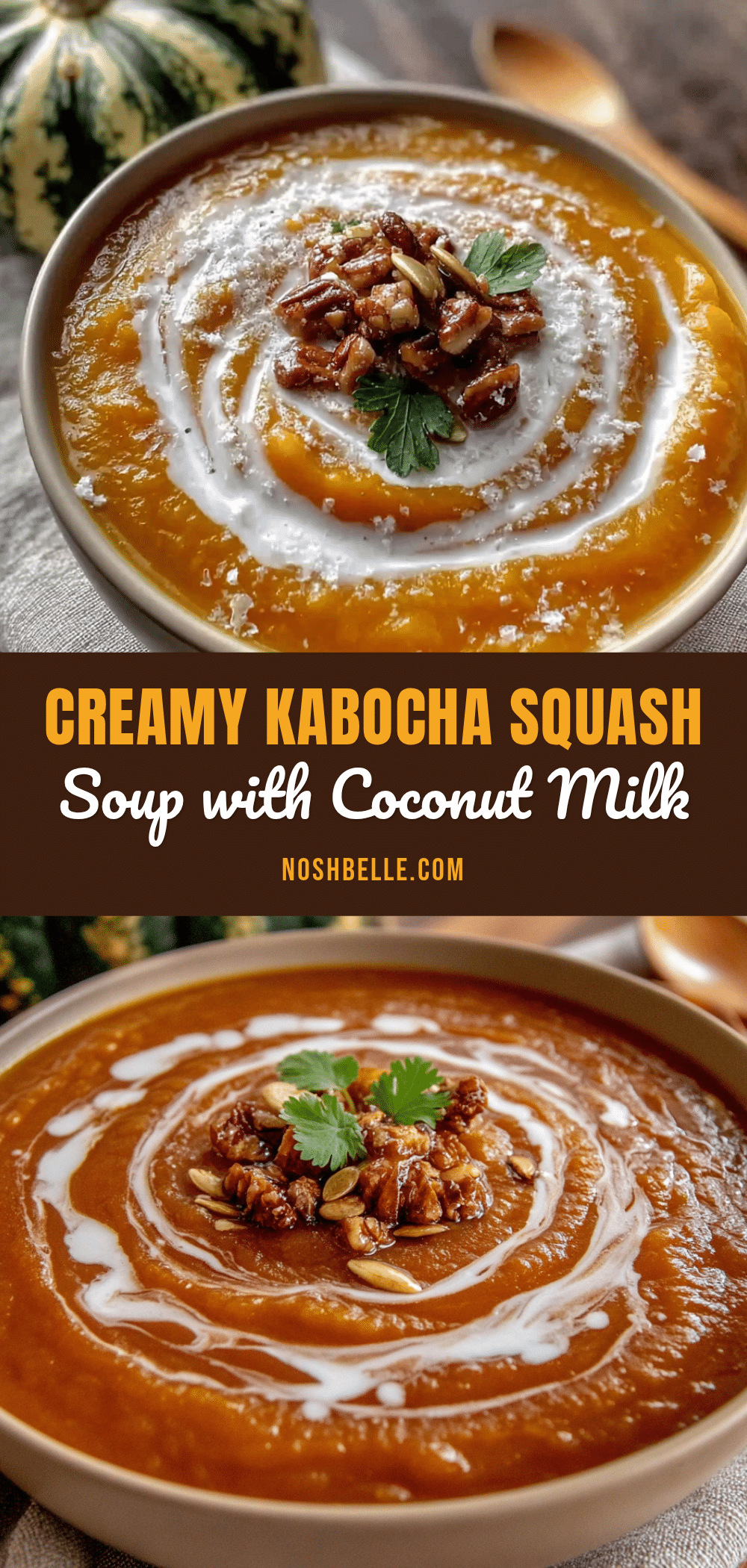
Creamy Kabocha Squash Soup with Coconut Milk

This velvety kabocha squash soup with coconut milk is roasted whole for natural creaminess, then blended with ginger and garlic for a deeply comforting, dairy-free bowl that even squash-haters love.
- Prep Time: 15 minutes
- Cook Time: 45 minutes
- Total Time: 1 hour
- Yield: 4 servings 1x
- Category: Soup
- Cuisine: American
Ingredients
- 1 medium kabocha squash (about 2–3 pounds)
- 1 can (13.5 oz) full-fat coconut milk
- 1 medium yellow onion, roughly chopped
- 3 cloves garlic, smashed
- 1 tablespoon fresh ginger, peeled and grated
- 2 cups vegetable broth, low-sodium
- 2 tablespoons coconut oil or olive oil
- 1 teaspoon salt
- ½ teaspoon black pepper, freshly ground
- Optional toppings: toasted pumpkin seeds, extra coconut cream, fresh cilantro, chili flakes
Instructions
- Preheat oven to 400°F (200°C). Carefully cut kabocha squash in half. Scoop out seeds and stringy bits.
- Rub cut sides with 1 tablespoon coconut oil. Place cut-side down on a parchment-lined baking sheet.
- Roast for 35-40 minutes until fork-tender. Let cool 10 minutes.
- While squash roasts, heat remaining 1 tablespoon coconut oil in a large pot over medium heat. Add onion and cook 5-6 minutes until translucent.
- Add smashed garlic and grated ginger. Cook 1 minute until fragrant.
- Scoop squash flesh from skin (keep about half the skin for texture). Add squash chunks and vegetable broth to pot. Bring to a gentle simmer, then reduce heat to low and cook 10 minutes.
- Remove from heat. Blend with an immersion blender or in batches in a countertop blender until smooth.
- Stir in full-fat coconut milk (start with ¾ can, add more to desired consistency). Season with salt and pepper.
- Warm over low heat for 5 minutes (do not boil). Adjust thickness with broth if needed.
- Ladle into bowls and top with desired toppings. Serve immediately.
Notes
Roasting the squash whole with skin on concentrates flavor and adds natural creaminess. Don’t skip fresh ginger—it brightens the soup. Season in layers for depth. Coconut milk can separate if boiled; keep at a gentle simmer. Soup tastes even better the next day.
Nutrition
- Serving Size: 1 cup
- Calories: 220
- Sugar: 8
- Sodium: 480
- Fat: 14
- Saturated Fat: 10
- Carbohydrates: 22
- Fiber: 5
- Protein: 4
Keywords: kabocha squash soup, creamy squash soup, coconut milk soup, vegan soup, dairy-free soup, fall soup, winter soup