It was 11:47 PM on a random Wednesday in October, and I had a very specific craving for something creamy, tangy, and topped with paprika. I didn’t have the patience for a full batch of classic deviled eggs, but I had a dozen hard-boiled eggs from earlier that week and a jar of light mayonnaise that was staring at me from the fridge. The idea arrived somewhere between the third episode of a show I wasn’t really watching and the realization that Halloween was only two days away. I wanted something festive, but I also didn’t want to undo a week of eating well. So I grabbed a piping bag, a squeeze of lemon, and a handful of black olives. Honestly, I wasn’t sure if this was going to be a triumph or a total mess—but at that hour, I didn’t really care. The kitchen was quiet, the counter was a little sticky, and my dog looked at me like I’d lost my mind. Maybe I had. But when I piped that first web onto a deviled egg and it actually looked like a spiderweb, I let out a little gasp. It was that kind of late-night kitchen magic you can’t recreate on purpose. I’ve made these Lighter Spooky Spiderweb Deviled Eggs every Halloween since, and they still give me that same jolt of silly, satisfying joy. Maybe you’ve been there—midnight, half-asleep, making something ridiculous that somehow becomes a tradition.
Why You’ll Love This Recipe
I’ve tested this recipe about six times to get the balance just right. It’s not just about making something that looks cute—it has to taste good too. Here’s why this version wins every time.
- Quick & Easy: You can have these ready in under 30 minutes if your eggs are already boiled. Perfect for last-minute Halloween parties or a fun snack before trick-or-treating.
- Simple Ingredients: You probably already have eggs, mayo, and mustard in your kitchen. The black olives are the only special item, and they’re cheap.
- Perfect for Halloween: These are the star of any spooky spread. Kids and adults both get a kick out of the spiderweb design.
- Lighter Twist: By swapping in light mayo, Greek yogurt, and cutting back on the egg yolks, you save calories without losing that creamy texture. It’s indulgence without the guilt.
- Crowd-Pleaser: I’ve brought these to three different parties, and they vanished every time. People ask for the recipe before they even finish eating.
What makes these different from other deviled eggs is the technique. Instead of a traditional filling, I use a mix of light mayonnaise, a little Dijon mustard, and a secret ingredient—a splash of pickle brine. It adds a brightness that cuts through the richness. Plus, the spiderweb design is surprisingly easy to pull off once you know the trick. Trust me, if I can do it at midnight, you can do it in broad daylight.
What Ingredients You Will Need
This recipe uses simple, wholesome ingredients to deliver that classic deviled egg flavor with a lighter touch. Most are pantry staples, so you won’t need a special trip to the store.
- 6 large eggs, hard-boiled and peeled (use eggs that are a week old for easier peeling)
- 3 tablespoons light mayonnaise (I prefer Hellmann’s or Duke’s for creaminess)
- 1 tablespoon plain Greek yogurt (adds tang without extra fat)
- 1 teaspoon Dijon mustard (smooth, not whole grain)
- 1 teaspoon pickle brine (from dill pickles—trust me on this)
- 1/4 teaspoon salt, plus more to taste
- 1/8 teaspoon black pepper
- 1/4 teaspoon smoked paprika, for garnish (regular paprika works too)
- 1 can (2.25 oz) sliced black olives, drained and patted dry (used for the spiderweb design)
- Optional: fresh chives, finely chopped, for extra color
For the spiderweb design, you’ll need the olive slices. I recommend getting the pre-sliced kind to save time. If you want a cleaner look, you can slice whole olives yourself into thin rounds. Just make sure they’re dry so the mayo sticks properly.
Equipment Needed
You don’t need fancy tools for this recipe, but a few items make the process smoother.
- Medium saucepan for boiling eggs (or an Instant Pot if you’re lazy like me)
- Sharp knife for halving eggs cleanly
- Small mixing bowl for the filling
- Fork or potato masher to mash the yolks
- Piping bag or zip-top bag for the spiderweb design
- Small round piping tip (Wilton #3 or similar) for precise lines
- Toothpick for dragging the web pattern
- Serving platter (a dark plate makes the webs pop)
I’ve used a zip-top bag in a pinch, and it works fine. Just snip a tiny corner off. If you don’t have a piping tip, you can use a toothpick to draw the web directly—it just takes a steady hand.
Preparation Method

- Hard-boil the eggs. Place eggs in a saucepan and cover with cold water by 1 inch. Bring to a boil over high heat, then cover, remove from heat, and let sit for 10 minutes. Transfer to an ice bath immediately. Let cool for 5 minutes, then peel. (Pro tip: older eggs peel easier. If your eggs are fresh, add a splash of vinegar to the water.)
- Slice the eggs in half lengthwise. Use a sharp knife and wipe it clean between cuts for neat edges. Gently pop out the yolks into a small bowl. Arrange the whites on a serving platter cut-side up.
- Make the filling. Add the light mayo, Greek yogurt, Dijon mustard, pickle brine, salt, and pepper to the yolks. Mash with a fork until smooth. Taste and adjust seasoning—I always add a pinch more salt. The mixture should be creamy but not runny.
- Pipe the filling. Spoon the yolk mixture into a piping bag fitted with a small round tip. Pipe a generous amount into each egg white, mounding slightly. If you don’t have a piping bag, use a zip-top bag with a corner snipped off.
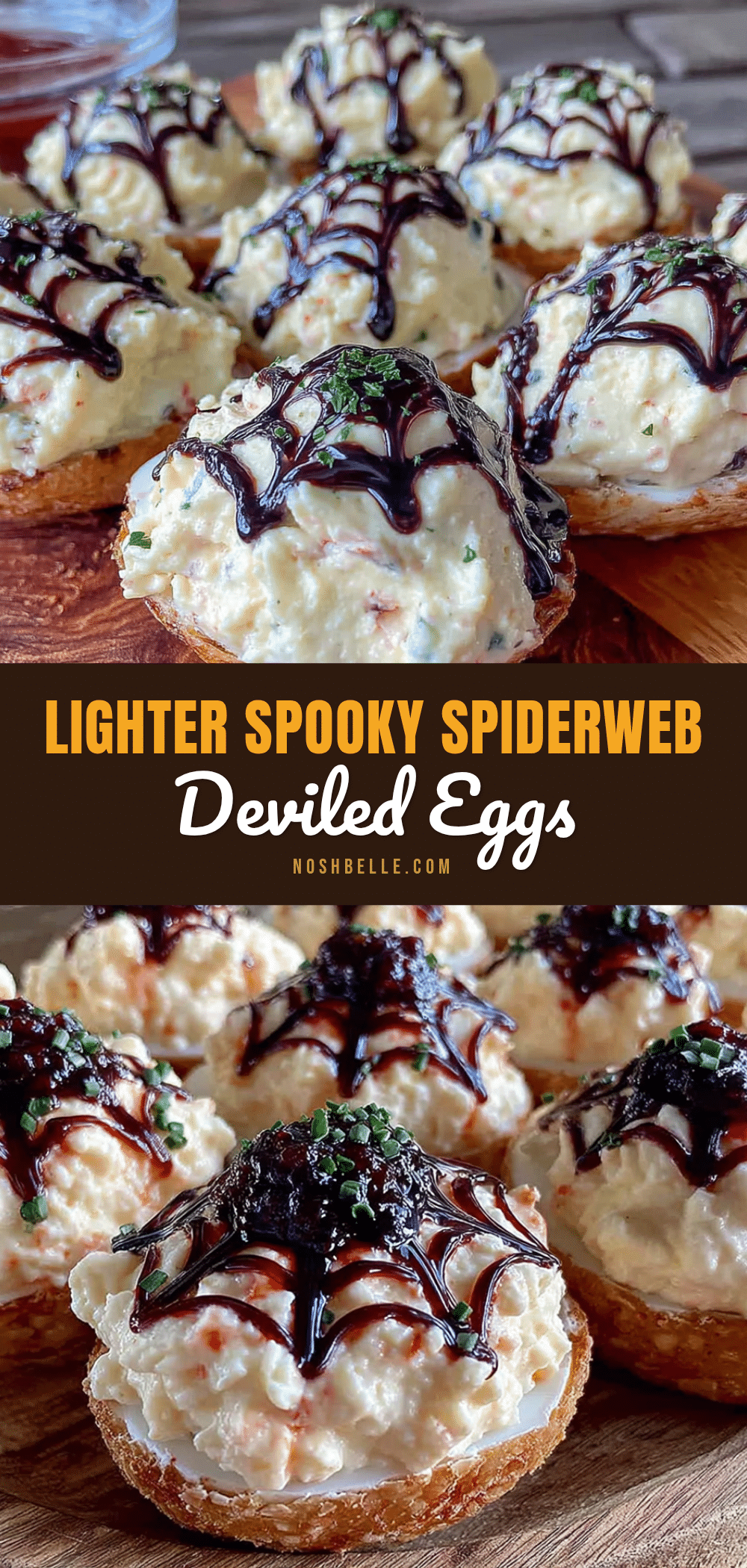
- Create the spiderweb. Take a dry olive slice and place it in the center of each filled egg. Starting from the olive, pipe a thin line of mayo outward to the edge of the egg white. Repeat 4-5 times around the olive, like spokes on a wheel. Then, using a toothpick, gently drag from the center outward through each mayo line, curving slightly to create a web effect. Wipe the toothpick clean between drags for sharp lines.
- Garnish and chill. Sprinkle a tiny pinch of smoked paprika over the eggs (avoid the webs if you want them to stay white). Add chopped chives if using. Refrigerate for at least 15 minutes before serving to let the flavors meld. The eggs will keep for up to 2 days in an airtight container.
Cooking Tips & Techniques
I’ve messed up this recipe more times than I’d like to admit. Here’s what I learned the hard way.
- Don’t overmix the filling. If you mash the yolks too vigorously, they can become gummy. A gentle fork mash is all you need. If the mixture is too thick, add a tiny splash of pickle brine or lemon juice.
- Dry your olives. Wet olives will make the mayo slide right off. Pat them dry with a paper towel before placing them on the eggs. This is the step I always forget, and then I’m left with a sad, slimy mess.
- Practice the web on a plate first. Before you commit to the eggs, try piping a test web on a clean plate. It helps you get the pressure right. Trust me, you don’t want to learn on your final dish.
- Use a toothpick for clean lines. When dragging the web, wipe the toothpick after each pull. If you don’t, the lines blur together and you lose the web effect. I learned this after my first batch looked like abstract art.
- Chill before serving. The flavors need time to meld. If you serve them right away, the mayo tastes flat. Give them at least 15 minutes in the fridge—overnight is even better.
Variations & Adaptations
This recipe is flexible, so feel free to make it your own.
- Gluten-Free: This recipe is naturally gluten-free. Just double-check your mayonnaise and mustard labels to be safe.
- Dairy-Free: Swap the Greek yogurt for a dairy-free alternative like coconut yogurt or just use extra light mayo. The texture will be slightly different but still delicious.
- Extra Spicy: Add a dash of cayenne pepper or hot sauce to the filling. I’ve done this for a Halloween party, and it gave the eggs a nice kick that paired well with the creamy filling.
- Vegan Version: Use silken tofu with black salt (kala namak) for an eggy flavor. The texture won’t be identical, but it’s surprisingly close. You can still do the spiderweb design with vegan mayo.
- Different Web Colors: Instead of white mayo, you can tint the piping mixture with a drop of black food coloring for a darker web. Just be careful—it stains everything.
Serving & Storage Suggestions
These eggs are best served chilled, straight from the fridge. Arrange them on a dark platter to make the spiderwebs pop. I like to add a few fake spiders or spider rings around the plate for extra Halloween flair. They pair well with other finger foods like veggie sticks, cheese cubes, or a bowl of popcorn. For drinks, a crisp white wine or a sparkling water with lime balances the richness.
To store, place the deviled eggs in a single layer in an airtight container. They’ll keep in the refrigerator for up to 2 days. Don’t freeze them—the texture will turn watery. If you’re making them ahead, assemble the eggs but don’t pipe the spiderwebs until just before serving. The mayo lines can bleed into the egg whites if left too long. I’ve made them the night before and added the webs the next morning with perfect results.
Nutritional Information & Benefits
Per serving (2 deviled eggs): approximately 120 calories, 8g fat, 2g saturated fat, 180mg cholesterol, 300mg sodium, 2g carbohydrates, 0g fiber, 1g sugar, 8g protein. These numbers are estimates and will vary based on your ingredients.
Using light mayo and Greek yogurt cuts the fat and calories by about 30% compared to traditional deviled eggs. Eggs are a great source of high-quality protein and choline, which supports brain health. The olive slices add healthy monounsaturated fats. This recipe is naturally low-carb and keto-friendly if you use full-fat mayo. It’s also a good option for anyone watching their weight without sacrificing flavor.
Conclusion
These Lighter Spooky Spiderweb Deviled Eggs are proof that you don’t need to choose between healthy eating and having fun with your food. They’re creamy, tangy, and just a little bit ridiculous—which is exactly what Halloween should be. I love how they make people smile when they see them, and I love even more that I can eat a few without feeling like I ruined my day. Give them a try, and don’t be afraid to get creative with the webs. If you make them, I’d love to hear how they turned out. Drop a comment below or tag me in your photos—I’m always amazed at what you all come up with. Happy Halloween, and happy eating!
Frequently Asked Questions
Can I make these eggs ahead of time?
Yes, you can boil and peel the eggs up to 3 days in advance. Assemble the filling and pipe it into the whites up to 24 hours ahead, but add the spiderweb design no more than 2 hours before serving for the best look.
How do I get clean spiderweb lines?
Use a small round piping tip and practice on a plate first. When dragging the toothpick, wipe it clean after each pull. Cold eggs also help the mayo hold its shape better.
Can I use a different design instead of a spiderweb?
Absolutely. You can pipe simple dots, zigzags, or even little ghost faces using the same technique. The olive slice can be replaced with a small piece of red bell pepper for a different look.
Why are my eggs hard to peel?
Fresh eggs are notoriously difficult to peel. Use eggs that are at least a week old, or add a splash of vinegar and a pinch of baking soda to the boiling water. An ice bath also helps the shell release.
Can I make this recipe vegan?
Yes. Use silken tofu blended with black salt, nutritional yeast, and a little mustard for the filling. Vegan mayo works for the spiderweb design. The texture will be softer, but the flavor is surprisingly eggy.
Pin This Recipe!
Best Lighter Spooky Spiderweb Deviled Eggs
These lighter deviled eggs feature a creamy, tangy filling with a fun spiderweb design made from black olives and mayo. Perfect for Halloween parties, they’re quick to make and a crowd-pleaser.
- Prep Time: 15 minutes
- Cook Time: 10 minutes
- Total Time: 25 minutes
- Yield: 6 servings 1x
- Category: Appetizer
- Cuisine: American
Ingredients
- 6 large eggs, hard-boiled and peeled
- 3 tablespoons light mayonnaise
- 1 tablespoon plain Greek yogurt
- 1 teaspoon Dijon mustard
- 1 teaspoon pickle brine
- 1/4 teaspoon salt, plus more to taste
- 1/8 teaspoon black pepper
- 1/4 teaspoon smoked paprika, for garnish
- 1 can (2.25 oz) sliced black olives, drained and patted dry
- Optional: fresh chives, finely chopped, for extra color
Instructions
- Hard-boil the eggs: Place eggs in a saucepan and cover with cold water by 1 inch. Bring to a boil over high heat, then cover, remove from heat, and let sit for 10 minutes. Transfer to an ice bath immediately. Let cool for 5 minutes, then peel.
- Slice the eggs in half lengthwise. Use a sharp knife and wipe it clean between cuts for neat edges. Gently pop out the yolks into a small bowl. Arrange the whites on a serving platter cut-side up.
- Make the filling: Add the light mayo, Greek yogurt, Dijon mustard, pickle brine, salt, and pepper to the yolks. Mash with a fork until smooth. Taste and adjust seasoning. The mixture should be creamy but not runny.
- Pipe the filling: Spoon the yolk mixture into a piping bag fitted with a small round tip. Pipe a generous amount into each egg white, mounding slightly. If you don’t have a piping bag, use a zip-top bag with a corner snipped off.
- Create the spiderweb: Take a dry olive slice and place it in the center of each filled egg. Starting from the olive, pipe a thin line of mayo outward to the edge of the egg white. Repeat 4-5 times around the olive, like spokes on a wheel. Then, using a toothpick, gently drag from the center outward through each mayo line, curving slightly to create a web effect. Wipe the toothpick clean between drags for sharp lines.
- Garnish and chill: Sprinkle a tiny pinch of smoked paprika over the eggs (avoid the webs if you want them to stay white). Add chopped chives if using. Refrigerate for at least 15 minutes before serving to let the flavors meld. The eggs will keep for up to 2 days in an airtight container.
Notes
Use eggs that are a week old for easier peeling. Dry olives thoroughly before placing on eggs to prevent mayo from sliding. Practice the web on a plate first. Chill before serving for best flavor. The spiderweb design can be added up to 2 hours before serving.
Nutrition
- Serving Size: 2 deviled eggs
- Calories: 120
- Sugar: 1
- Sodium: 300
- Fat: 8
- Saturated Fat: 2
- Carbohydrates: 2
- Protein: 8
Keywords: deviled eggs, spiderweb, Halloween, light, healthy, appetizer, party food